Patent – Detailed Explanation (Cyber Law & IPR Context)
Introduction
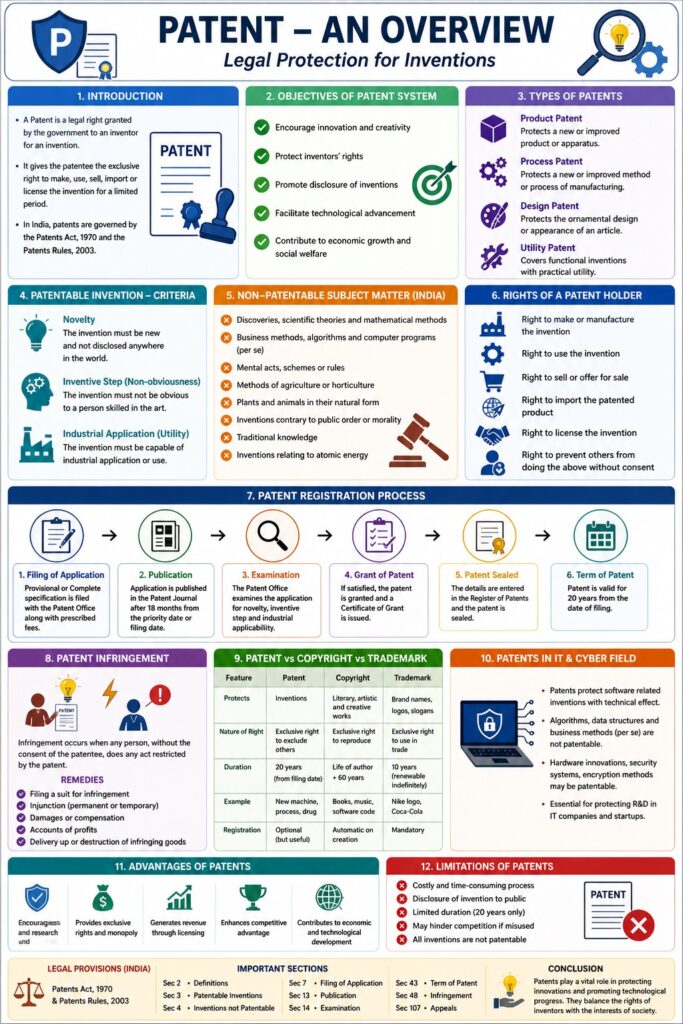
A Patent is a form of Intellectual Property Right (IPR) that grants an inventor exclusive legal rights over an invention for a limited period.
👉 “Patent = Legal protection for inventions.”
In India, patents are governed by the
Patents Act, 1970
Definition
A Patent is:
- A legal right granted by the government
- To an inventor
- To exclude others from making, using, or selling the invention
Objectives of Patent System
- Encourage innovation
- Protect inventors’ rights
- Promote technological development
- Provide public disclosure of inventions
Types of Patents
1. Product Patent
- Protects a physical product
📌 Example: New medicine
2. Process Patent
- Protects a method or process
📌 Example: Manufacturing method
3. Design Patent (Industrial Design)
- Protects design and appearance
4. Utility Patent
- Covers functional inventions
Patentable Inventions (Criteria)
To get a patent, an invention must be:
1. Novel (New)
- Must not be previously known
2. Inventive Step (Non-obvious)
- Must not be obvious to experts
3. Industrial Application
- Must be useful in industry
Non-Patentable Inventions (India)
Under Indian law, the following are not patentable:
- Scientific discoveries
- Mathematical methods
- Business methods
- Software (in certain cases)
- Natural substances
Patent Rights
A patent holder has the right to:
- Manufacture the invention
- Use the invention
- Sell or license the invention
- Prevent others from using it
Duration of Patent
- 20 years from filing date
📌 After expiry → public domain
Patent Registration Process
Step 1: Filing Application
- Submit invention details
Step 2: Publication
- Published after 18 months
Step 3: Examination
- Patent office examines application
Step 4: Grant of Patent
- Patent is granted if criteria met
Patent Infringement
Definition
Unauthorized use of patented invention
Remedies
- Legal action
- Compensation
- Injunction
Patent vs Copyright vs Trademark
| Feature | Patent | Copyright | Trademark |
|---|---|---|---|
| Protects | Inventions | Creative works | Brand names |
| Duration | 20 years | Lifetime + years | Renewable |
| Example | Machine | Book | Logo |
Patents in Cyber and IT Field
- Software-related inventions
- Algorithms (with technical effect)
- Hardware innovations
📌 Important for tech companies
Advantages of Patents
- Encourages innovation
- Provides exclusive rights
- Generates revenue through licensing
- Promotes research
Limitations
- Costly process
- Time-consuming
- Limited duration
- Disclosure required
Patent and Cyber Law
- Protects digital innovations
- Prevents misuse of technology
- Supports IT industry growth
Real-Life Examples
- Pharmaceutical patents
- Technology patents (processors, chips)
- Software innovations
Conclusion
Patents play a crucial role in protecting innovations and technological advancements. By granting exclusive rights, they encourage inventors to develop new ideas while contributing to economic growth and technological progress.
📘 MCA Exam Tip
For 10–15 marks:
- Definition
- Types of patents
- Patentability criteria
- Process
- Advantages + examples