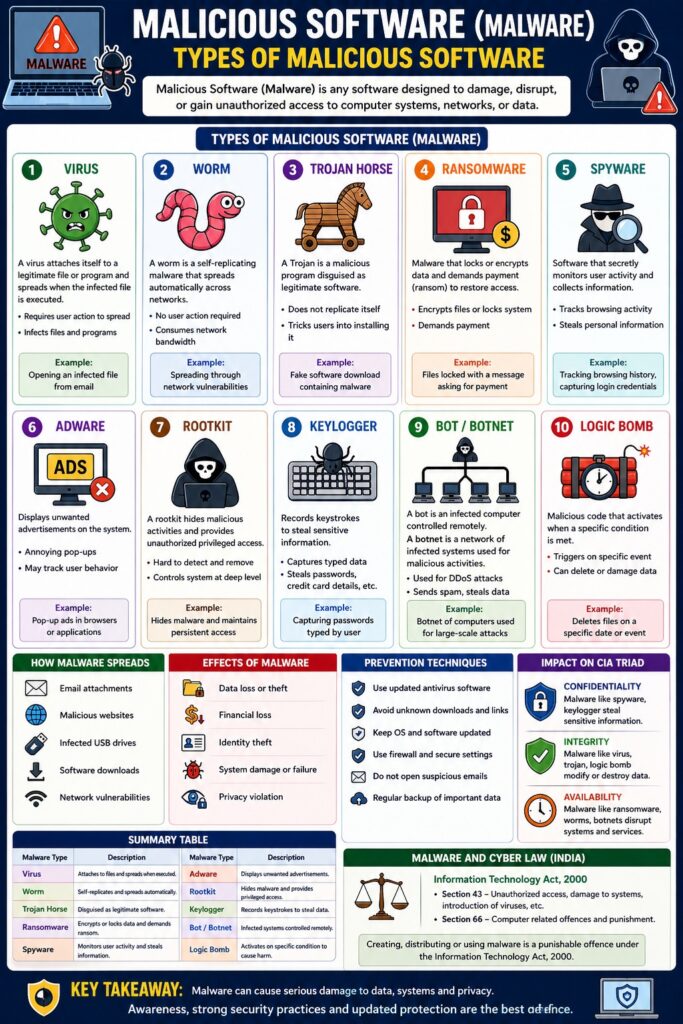
Malicious Software (Malware): Types of Malware
Introduction
Malicious Software (Malware) refers to any software designed to damage, disrupt, or gain unauthorized access to computer systems, networks, or data.
👉 “Malware = Malicious + Software”
It is one of the most common threats in Information Security, affecting individuals, organizations, and governments.
Meaning of Malware
Malware is a program that:
- Performs unauthorized actions
- Steals or damages data
- Disrupts system operations
📌 It spreads through:
- Email attachments
- Malicious websites
- Infected USB drives
- Software downloads
Types of Malicious Software (Malware)
1. Virus
Meaning
A virus is a malicious program that attaches itself to a file or program and spreads when executed.
Characteristics
- Requires user action to spread
- Infects files
Example
Opening an infected file from email
2. Worm
Meaning
A worm is a self-replicating malware that spreads automatically across networks.
Characteristics
- No user action required
- Consumes network bandwidth
Example
Spreading through network vulnerabilities
3. Trojan Horse
Meaning
A Trojan is a malicious program disguised as legitimate software.
Characteristics
- Does not replicate
- Tricks users
Example
Fake software download containing malware
4. Ransomware
Meaning
Malware that locks or encrypts data and demands payment (ransom) to restore access.
Example
Files locked with a message asking for payment
5. Spyware
Meaning
Software that secretly monitors user activity and collects information.
Examples
- Tracking browsing history
- Capturing login credentials
6. Adware
Meaning
Displays unwanted advertisements.
Characteristics
- Annoying pop-ups
- May track user behavior
7. Rootkit
Meaning
A rootkit hides malicious activities and provides unauthorized privileged access.
Characteristics
- Hard to detect
- Controls system at deep level
8. Keylogger
Meaning
Records keystrokes to steal sensitive data.
Example
Capturing passwords typed by user
9. Bot / Botnet
Meaning
A bot is an infected computer controlled remotely.
Botnet
A network of infected systems used for attacks.
Example
Used in DDoS attacks
10. Logic Bomb
Meaning
Malicious code that activates when a specific condition is met.
Example
Deletes files on a specific date
Summary Table
| Malware Type | Description |
|---|---|
| Virus | Attaches to files |
| Worm | Self-replicates |
| Trojan | Disguised as legitimate |
| Ransomware | Encrypts data for ransom |
| Spyware | Spies on user |
| Adware | Shows ads |
| Rootkit | Hides malware |
| Keylogger | Records keystrokes |
| Botnet | Remote-controlled systems |
| Logic Bomb | Condition-based attack |
Malware and CIA Triad
- Confidentiality → Data theft (spyware, keylogger)
- Integrity → Data modification (virus)
- Availability → System disruption (ransomware, worms)
Effects of Malware
- Data loss
- Financial loss
- Identity theft
- System damage
- Privacy violation
Prevention Techniques
- Use antivirus software
- Avoid unknown downloads
- Regular system updates
- Use firewalls
- Do not open suspicious emails
Malware and Cyber Law (India)
Under IT Act, 2000:
- Section 43 → Damage to systems
- Section 66 → Computer-related offences
📌 Malware attacks are punishable offences.
Real-Life Examples
- Ransomware attacks on hospitals
- Spyware stealing banking details
- Botnets used for cyber attacks
Conclusion
Malware is a serious threat to computer security, capable of causing data loss, financial damage, and system failure. Understanding different types of malware helps in prevention, detection, and protection. Strong security practices are essential to safeguard systems and data.
📘 MCA Exam Tip
For 10–15 marks:
- Define malware
- Explain 6–10 types
- Add examples
- Include prevention methods