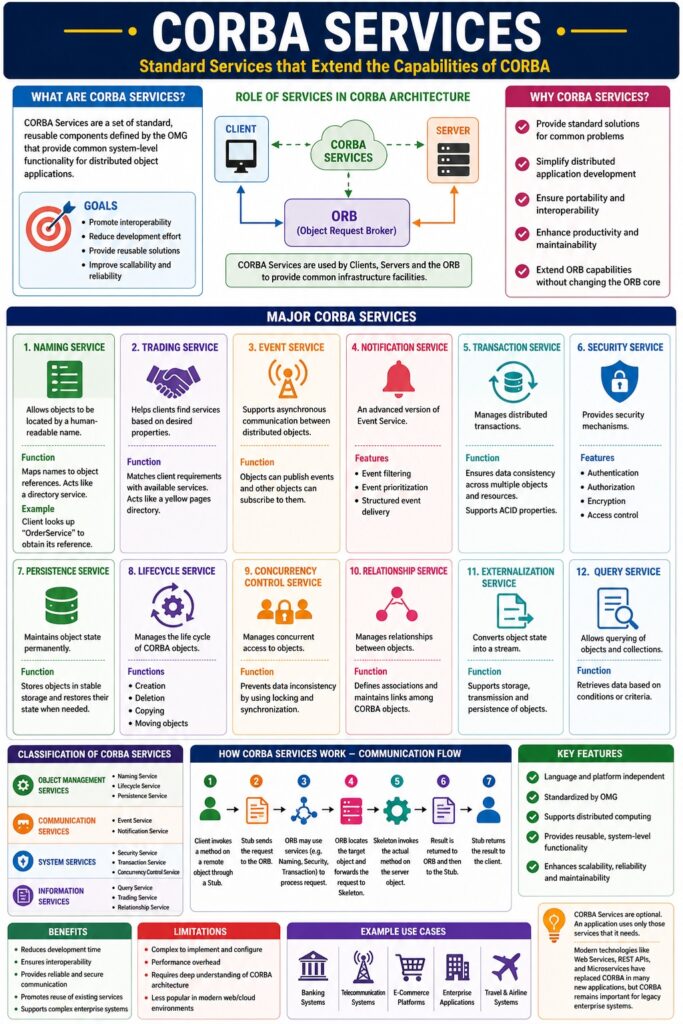
Below is a clear, structured, and detailed discussion of CORBA Services, presented in a technical and concept-oriented academic format.
CORBA Services (CORBAservices) – Detailed Explanation
Introduction
CORBA Services are a set of standard system-level services defined by the Object Management Group (OMG) to support distributed object applications built using CORBA.
These services provide common functionalities such as naming, security, transactions, and persistence, allowing developers to focus on business logic instead of low-level system details.
What are CORBA Services
CORBA services are:
- Predefined reusable components
- Provide infrastructure-level support
- Used by distributed applications
- Independent of programming language
📌 They extend the capabilities of the ORB.
Need for CORBA Services
CORBA services are required to:
- Simplify distributed application development
- Provide standard solutions for common problems
- Ensure interoperability
- Improve scalability and maintainability
Major CORBA Services
CORBA defines several standard services. The most important ones are discussed below:
1. Naming Service
Purpose
- Allows objects to be located by name
Function
- Maps names → object references
- Works like a directory service
Example
Client looks up:
"CalculatorService"
2. Trading Service
Purpose
- Helps clients find services based on properties
Function
- Matches client requirements with available services
- Acts like a yellow pages directory
3. Event Service
Purpose
- Supports asynchronous communication
Function
- Allows objects to send and receive events
- Decouples sender and receiver
4. Notification Service
Purpose
- Advanced version of Event Service
Features
- Event filtering
- Event prioritization
- Structured messaging
5. Transaction Service
Purpose
- Manages distributed transactions
Function
- Ensures data consistency
- Supports ACID properties
6. Security Service
Purpose
- Provides security mechanisms
Features
- Authentication
- Authorization
- Encryption
- Access control
7. Persistence Service
Purpose
- Maintains object state permanently
Function
- Saves objects in storage
- Restores object state when needed
8. Lifecycle Service
Purpose
- Manages object lifecycle
Function
- Creation
- Deletion
- Copying
- Moving objects
9. Concurrency Control Service
Purpose
- Manages concurrent access to objects
Function
- Prevents data inconsistency
- Supports locking mechanisms
10. Relationship Service
Purpose
- Manages relationships between objects
Function
- Defines associations
- Maintains object links
11. Externalization Service
Purpose
- Converts object state into a stream
Function
- Supports storage and transmission
12. Query Service
Purpose
- Allows querying of objects
Function
- Retrieves data based on conditions
Classification of CORBA Services
1. Object Management Services
- Naming
- Lifecycle
- Persistence
2. Communication Services
- Event
- Notification
3. System Services
- Security
- Transactions
- Concurrency
4. Information Services
- Query
- Relationship
Advantages of CORBA Services
- Standardized solutions
- Reduces development effort
- Improves interoperability
- Enhances scalability
- Promotes reuse
Limitations
- Complex to implement
- Heavyweight architecture
- Performance overhead
- Less relevant in modern systems
Modern Alternatives
- REST APIs
- Microservices
- Cloud-based services
- gRPC
Conclusion
CORBA services provide a comprehensive set of standardized functionalities that support distributed applications by handling common system-level tasks such as naming, security, transactions, and event communication. Although CORBA is less commonly used today, its services remain an important foundation for understanding middleware and distributed system design.