Below is a clear, structured, and detailed discussion of
Common Object Request Broker Architecture (CORBA): Overview of Technical Architecture, presented in a technical and concept-oriented academic format.
CORBA: Overview of Technical Architecture
Introduction
CORBA (Common Object Request Broker Architecture) is a standard defined by the Object Management Group (OMG) for enabling communication between distributed objects written in different programming languages and running on different platforms.
CORBA provides a middleware framework that allows objects to interact seamlessly in a heterogeneous distributed environment.
What is CORBA Architecture
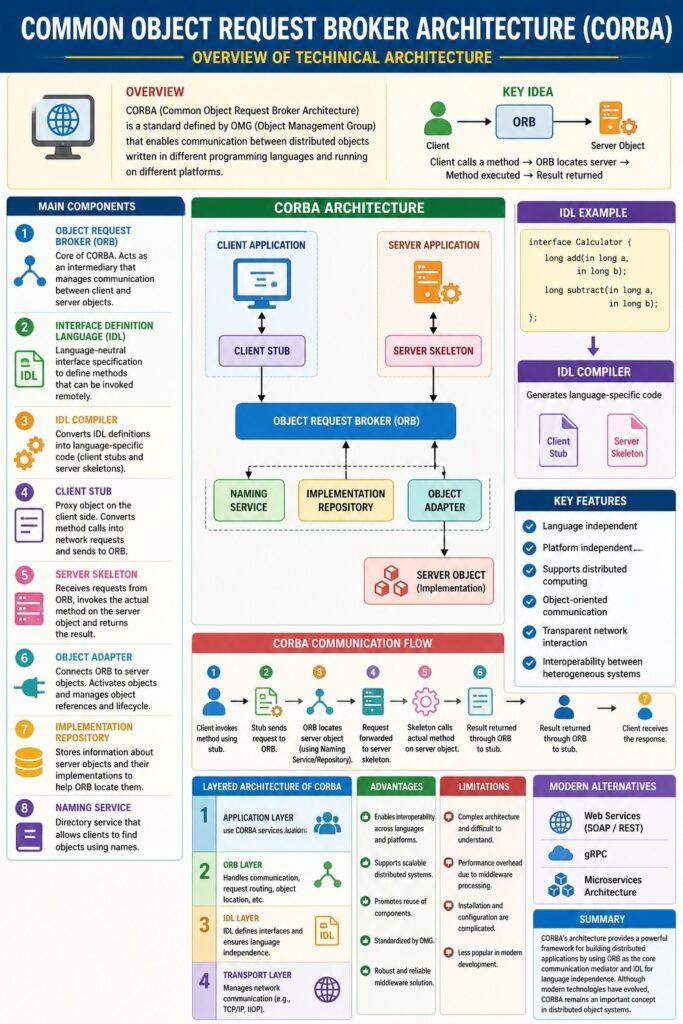
CORBA architecture is based on the concept of an Object Request Broker (ORB), which acts as a communication mediator between client and server objects.
Key Idea
- Client calls a method → ORB locates server → method executed → result returned
Main Components of CORBA Architecture
The technical architecture of CORBA consists of the following major components:
1. Object Request Broker (ORB)
Definition
The ORB is the core component of CORBA.
Responsibilities
- Handles communication between client and server
- Locates remote objects
- Manages method invocation
- Transfers requests and responses
📌 Acts like a middleware bridge in distributed systems.
2. Interface Definition Language (IDL)
Definition
IDL is a language-neutral interface specification used to define methods that can be invoked remotely.
Purpose
- Enables communication between different programming languages
- Defines object interfaces independent of implementation
Example
interface Calculator {
    long add(in long a, in long b);
};
3. IDL Compiler
Function
- Converts IDL definitions into language-specific code
- Generates:
- Client stubs
- Server skeletons
4. Client Stub
Definition
A stub is a proxy object on the client side.
Function
- Represents remote object locally
- Converts method calls into network requests
5. Server Skeleton
Definition
Skeleton is the server-side counterpart of stub.
Function
- Receives client requests
- Invokes actual method on server object
- Sends result back
6. Object Adapter
Definition
Object adapter connects ORB with server objects.
Responsibilities
- Activates objects
- Handles object references
- Manages object lifecycle
7. Implementation Repository
Purpose
- Stores information about server objects
- Helps ORB locate object implementations
8. Naming Service
Function
- Allows clients to find objects by name
- Acts like a directory service
CORBA Communication Flow
- Client invokes method using stub
- Stub sends request to ORB
- ORB locates server object
- Request forwarded to server skeleton
- Skeleton calls actual method
- Result returned through ORB
- Client receives response
Layered Architecture of CORBA
1. Application Layer
- Client and server applications
2. ORB Layer
- Communication management
- Request routing
3. IDL Layer
- Interface definition
- Language independence
4. Transport Layer
- Network communication (TCP/IP)
Features of CORBA Architecture
- Language independent
- Platform independent
- Supports distributed computing
- Object-oriented communication
- Transparent network interaction
Advantages of CORBA
- Enables interoperability
- Supports heterogeneous systems
- Scalable distributed architecture
- Reusable components
Limitations of CORBA
- Complex architecture
- Difficult to implement
- Performance overhead
- Less used in modern systems
Modern Alternatives
- Web Services (SOAP/REST)
- Microservices architecture
- gRPC
Conclusion
CORBA provides a powerful architecture for building distributed systems by enabling communication between objects across different platforms and languages. Its core component, the ORB, manages all interactions, while IDL ensures interoperability. Although CORBA is less common in modern development, it remains an important concept in understanding distributed object systems and middleware architecture.