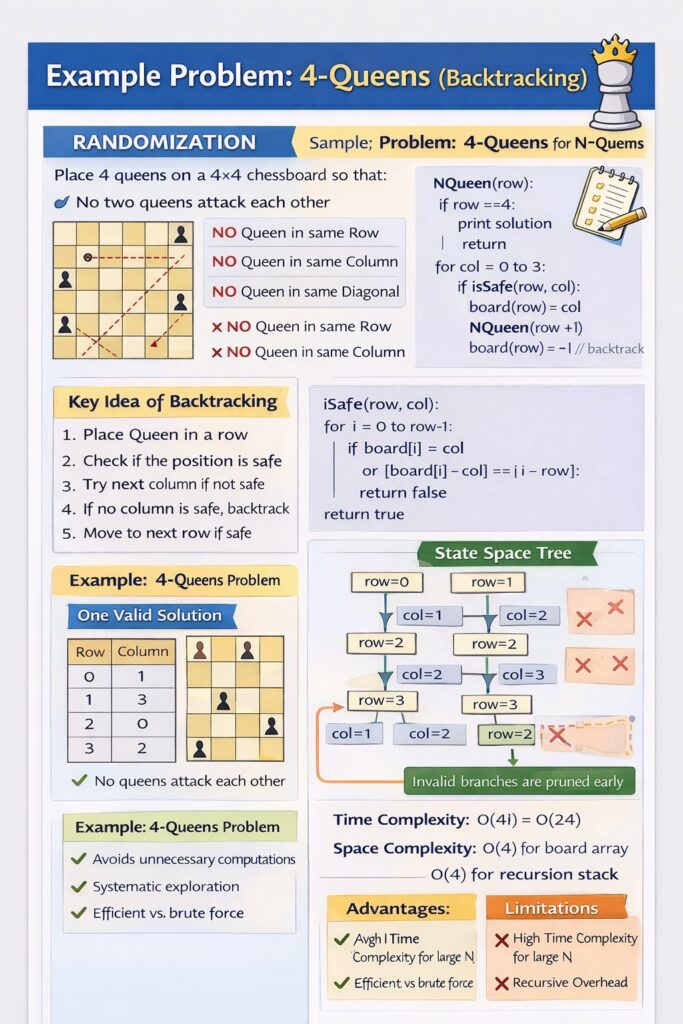
📘 Example Problem on Backtracking: N-Queens Problem
1️⃣ Introduction
The N-Queens problem is a classical problem used to explain the Backtracking algorithm design technique.
🔹 Problem Statement
Place N queens on an N × N chessboard such that:
- No two queens attack each other
- That means:
- No two queens in the same row
- No two queens in the same column
- No two queens on the same diagonal
2️⃣ Why N-Queens Uses Backtracking
- Each queen placement is a decision
- If a conflict occurs, we undo (backtrack) the decision
- The solution is built incrementally
- Exhaustive search is avoided by pruning invalid states
3️⃣ Basic Idea of Backtracking in N-Queens
- Place one queen in a row
- Check if the position is safe
- If safe, move to the next row
- If not safe, try next column
- If no column works, backtrack to previous row
4️⃣ Representation of the Solution
- Use a 1-D array
board[] board[i] = jmeans
Queen is placed in row i, column j
5️⃣ Safety Condition (Key Logic)
A queen at position (row, col) is safe if:
- No queen is in the same column
- No queen is on the left diagonal
- No queen is on the right diagonal
🔹 Mathematical Conditions
For all previous rows i < row:
board[i] ≠ col|board[i] − col| ≠ |i − row|
6️⃣ Algorithm for N-Queens (Backtracking)
🔹 Pseudocode
NQueen(row):
   if row == N:
       print solution
       return

   for col = 0 to N-1:
       if isSafe(row, col):
           board[row] = col
           NQueen(row + 1)
           board[row] = -1   // backtrack
🔹 isSafe Function
isSafe(row, col):
   for i = 0 to row-1:
       if board[i] == col
          or |board[i] - col| == |i - row|:
           return false
   return true
7️⃣ Example: 4-Queens Problem
🔹 One Valid Solution
| Row | Column |
|---|---|
| 0 | 1 |
| 1 | 3 |
| 2 | 0 |
| 3 | 2 |
🔹 Board Representation
. Q . .
. . . Q
Q . . .
. . Q .
✔ No queens attack each other
8️⃣ State Space Tree (Concept)
- Each level represents a row
- Each branch represents a column choice
- Invalid branches are pruned early
This drastically reduces search space compared to brute force.
9️⃣ Time and Space Complexity
🔹 Time Complexity
- Worst case: O(N!)
- Practical performance is much better due to pruning
🔹 Space Complexity
- Board array: O(N)
- Recursion stack: O(N)
🔟 Advantages of Using Backtracking
✔ Avoids unnecessary computations
✔ Systematic exploration
✔ Efficient compared to brute force
1️⃣1️⃣ Limitations
✖ High time complexity for large N
✖ Recursive overhead
1️⃣2️⃣ Applications of N-Queens / Backtracking
- Sudoku solver
- Graph coloring
- Hamiltonian paths
- Puzzle solving
🔚 Conclusion
The N-Queens problem is a classic example that demonstrates the power of backtracking in solving constraint-satisfaction problems.
Backtracking explores all possibilities but abandons paths that violate constraints early.