
JSP Architecture (JavaServer Pages)
Introduction
JavaServer Pages (JSP) is a server-side technology used to create dynamic web pages using Java. JSP architecture defines how a JSP page is processed, translated, compiled, executed, and how it interacts with the web container to generate dynamic content. JSP follows a request–response model and is built on top of Servlet technology.
Core Idea of JSP Architecture
Internally, every JSP page is converted into a servlet by the JSP engine. This servlet is then compiled and executed by the servlet container. Because of this, JSP is often described as a high-level abstraction of servlets, designed mainly for presentation logic.
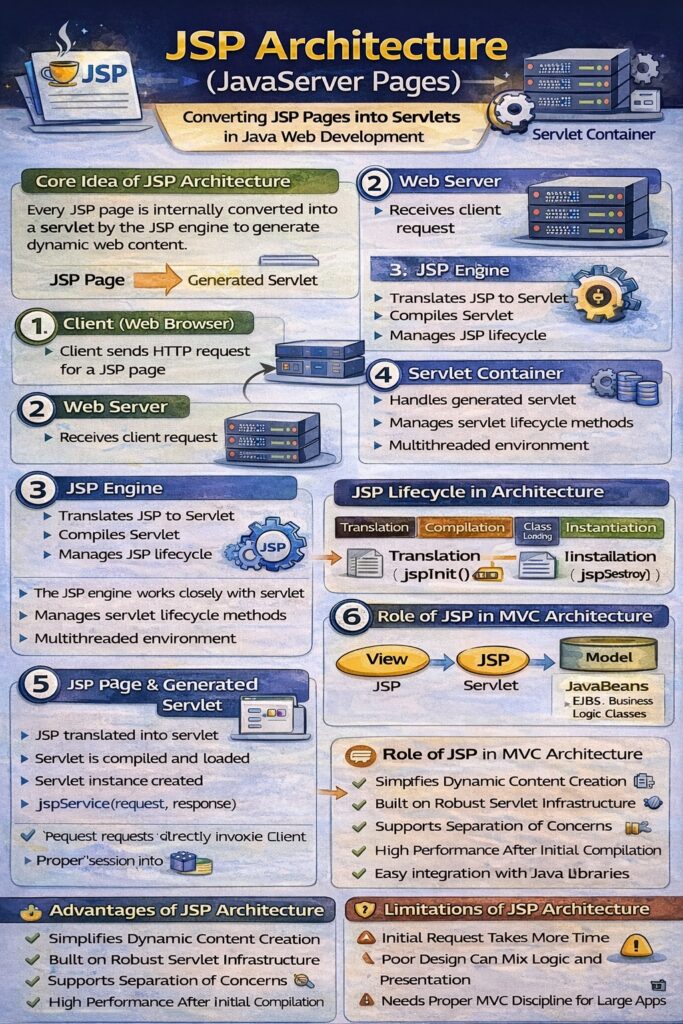
Components of JSP Architecture
JSP architecture consists of the following major components:
- Client (Web Browser)
- Web Server
- JSP Engine
- Servlet Container
- JSP Page and Generated Servlet
- JavaBeans / Model Components
1. Client
The client is typically a web browser that sends an HTTP request for a JSP page. The browser is unaware of the internal JSP processing and only receives the final HTML response.
2. Web Server
The web server receives the client request and forwards it to the JSP engine when a JSP resource is requested.
3. JSP Engine
The JSP engine is responsible for:
- Translating JSP pages into servlets
- Compiling the generated servlet
- Managing JSP lifecycle
The JSP engine works closely with the servlet container.
4. Servlet Container
The servlet container:
- Loads and manages the generated servlet
- Handles request and response objects
- Manages lifecycle methods
- Supports multithreading
Once compiled, the JSP behaves exactly like a servlet.
5. JSP Page and Generated Servlet
When a JSP page is requested for the first time:
- JSP page is translated into a servlet
- Servlet source code is generated
- Servlet is compiled into bytecode
- Servlet instance is created
- JSP lifecycle methods are executed
Subsequent requests directly invoke the compiled servlet unless the JSP file is modified.
6. JavaBeans and Model Components
JSP architecture supports separation of concerns using:
- JavaBeans for business logic
- JSP for presentation logic
- Servlets for controller logic (MVC pattern)
JavaBeans are used to store data and perform business operations, which JSP pages access using standard tags or expression language.
JSP Lifecycle in Architecture
The JSP lifecycle consists of the following phases:
- Translation
- Compilation
- Class Loading
- Instantiation
- Initialization (
jspInit()) - Request Processing (
_jspService()) - Destruction (
jspDestroy())
Request Processing Flow
- Client requests a JSP page
- Web server forwards request to JSP engine
- JSP engine translates JSP into servlet
- Servlet container compiles and loads servlet
_jspService()handles the request- Response is sent back to the client
Role of JSP in MVC Architecture
- Model: JavaBeans, EJBs, business logic classes
- View: JSP pages
- Controller: Servlets
This architecture improves maintainability, scalability, and readability of web applications.
Advantages of JSP Architecture
- Simplifies dynamic content creation
- Built on robust servlet infrastructure
- Supports separation of concerns
- High performance after initial compilation
- Easy integration with Java libraries
Limitations of JSP Architecture
- Initial request takes more time due to translation and compilation
- Poor design can mix logic and presentation
- Requires proper MVC discipline for large applications
Conclusion
JSP architecture defines a structured mechanism for converting JSP pages into servlets and processing client requests efficiently. By leveraging the servlet container and JSP engine, JSP provides a powerful yet simplified way to generate dynamic web content. Its close integration with servlets and support for MVC architecture makes JSP a fundamental technology in Java-based web application development.