
Below is a clear, structured, and detailed discussion of the Introduction to Struts Framework, written in the same technical and academic style as your earlier Java web technology topics.
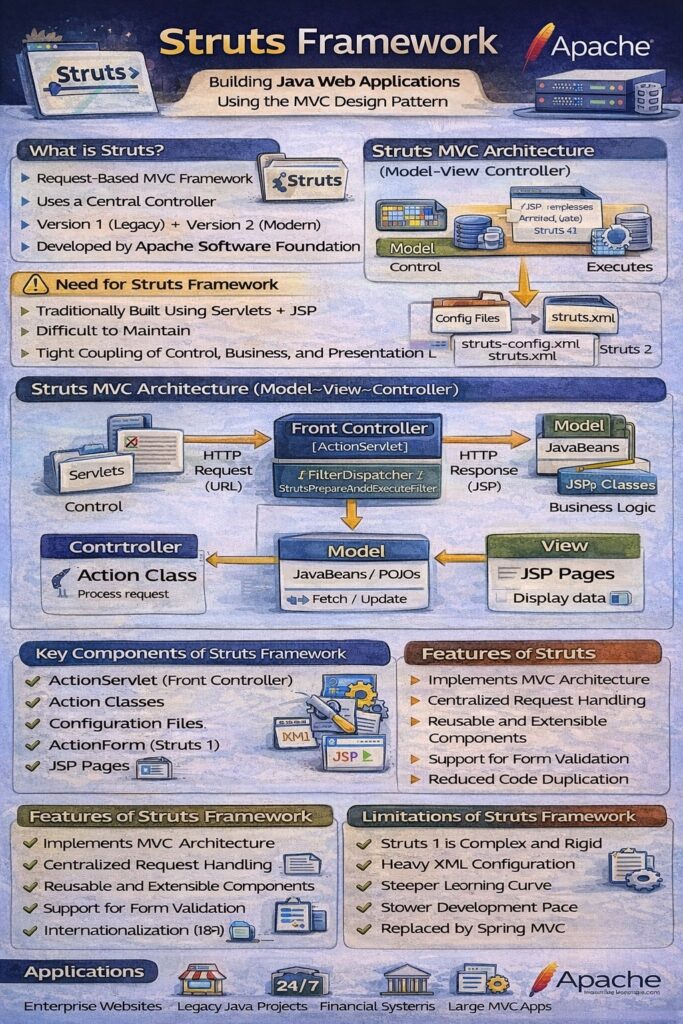
Struts Framework – Introduction
Introduction
The Struts Framework is an open-source Java web application framework developed by the Apache Software Foundation. It is used to build scalable, maintainable, and structured web applications by implementing the Model–View–Controller (MVC) design pattern.
Struts provides a systematic way to separate business logic, presentation, and control logic, making Java web applications easier to develop and maintain compared to traditional servlet-based applications.
Need for Struts Framework
Before frameworks like Struts, Java web applications were developed using:
- Servlets for control logic
- JSP for presentation
- Java classes for business logic
This approach often resulted in:
- Tight coupling between components
- Repeated code
- Difficult maintenance
- Poor separation of concerns
Struts was introduced to solve these problems by providing a centralized controller and a well-defined architecture.
What is Struts
Struts is a request-based MVC framework that:
- Uses a front controller to handle all requests
- Maps requests to specific action classes
- Separates navigation logic from business logic
- Uses JSP pages for the view layer
Struts exists in two major versions:
- Struts 1 (Legacy, XML-based)
- Struts 2 (Modern, flexible, OGNL-based)
Struts Architecture (MVC Based)
Model
- Represents business logic and data
- Implemented using JavaBeans, POJOs, or service classes
- Interacts with databases or other backend systems
View
- Represents the user interface
- Implemented using JSP pages
- Uses Struts tag libraries to simplify UI development
Controller
- Implemented using:
ActionServlet(Struts 1)FilterDispatcher/StrutsPrepareAndExecuteFilter(Struts 2)
- Receives and processes client requests
- Controls navigation between views
Key Components of Struts Framework
1. ActionServlet (Front Controller)
- Central controller of the application
- Receives all client requests
- Reads configuration files
- Delegates requests to appropriate Action classes
2. Action Class
- Contains request-processing logic
- Acts as a bridge between View and Model
- Returns navigation outcome
3. ActionForm (Struts 1)
- Used to store form data
- Acts as a data carrier between JSP and Action class
- Automatically populated by the framework
4. Configuration Files
struts-config.xml(Struts 1)struts.xml(Struts 2)
These files define:
- Action mappings
- Form beans
- Navigation rules
5. JSP Pages
- Used for presentation
- Use Struts tag libraries to reduce Java code in JSP
Request Processing Flow in Struts
- Client sends a request
- Request reaches the front controller
- Controller reads configuration
- Appropriate Action class is invoked
- Business logic is executed
- Result is returned
- Navigation to appropriate JSP page
- Response sent back to client
Features of Struts Framework
- Implements MVC architecture
- Centralized request handling
- Reusable components
- Form validation support
- Internationalization (i18n)
- Tag libraries for JSP
- Configurable navigation flow
Advantages of Struts
- Clear separation of concerns
- Improved maintainability
- Reduced code duplication
- Better team collaboration
- Suitable for large enterprise applications
Limitations of Struts
- Struts 1 is complex and rigid
- Heavy XML configuration
- Steeper learning curve
- Slower development compared to modern frameworks
- Gradually replaced by Spring MVC and Struts 2
Applications of Struts
- Enterprise web applications
- Banking and financial systems
- Legacy Java web projects
- Large-scale MVC-based applications
Conclusion
The Struts framework provides a structured and disciplined approach to Java web application development by enforcing the MVC design pattern. It simplifies request handling, improves code organization, and enhances maintainability. Although modern frameworks have replaced Struts in many projects, understanding Struts remains important for maintaining legacy systems and for gaining strong foundational knowledge of Java web application architecture.