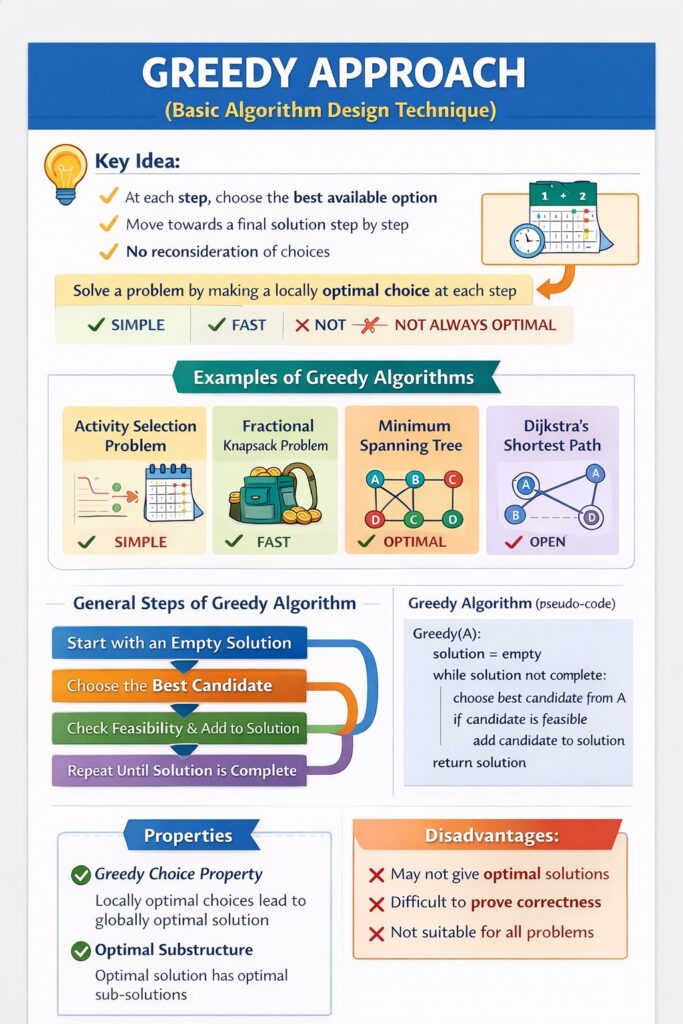
📘 Greedy Approach
(Basic Algorithm Design Technique)
1️⃣ Introduction
The Greedy approach is an algorithm design technique in which a solution is built step by step by making the locally optimal choice at each stage, with the hope that these local choices lead to a globally optimal solution.
A greedy algorithm never reconsiders its decisions once they are made.
2️⃣ Key Idea of Greedy Approach
At each step:
- Select the best available option
- Do not look ahead or backtrack
- Move towards the final solution
✔ Simple
✔ Fast
✖ Not always optimal for every problem
3️⃣ Characteristics of Greedy Algorithms
A problem must satisfy the following properties to be solved optimally using greedy approach:
🔹 1. Greedy Choice Property
A globally optimal solution can be obtained by making a locally optimal choice.
🔹 2. Optimal Substructure
An optimal solution contains optimal solutions to its sub-problems.
4️⃣ General Steps of Greedy Algorithm
- Start with an empty solution
- At each step, choose the best candidate
- Add it to the solution
- Repeat until solution is complete
5️⃣ Generic Greedy Algorithm (Pseudo-code)
Greedy(A):
   solution = empty
   while solution not complete:
       choose best candidate from A
       if candidate is feasible:
           add candidate to solution
   return solution
6️⃣ Examples of Greedy Algorithms
🔹 1. Activity Selection Problem
- Select maximum number of non-overlapping activities
- Choice: activity with earliest finishing time
Time Complexity: O(n log n)
🔹 2. Fractional Knapsack Problem
- Items can be divided
- Choice: highest value/weight ratio
Time Complexity: O(n log n)
🔹 3. Minimum Spanning Tree (MST)
(a) Kruskal’s Algorithm
- Select minimum weight edges
- Avoid cycles
Time Complexity: O(E log E)
(b) Prim’s Algorithm
- Expand tree from a vertex
- Choose minimum weight edge
Time Complexity: O(E log V)
🔹 4. Dijkstra’s Shortest Path Algorithm
- Finds shortest path from a source vertex
- Greedy choice: closest unvisited vertex
Time Complexity: O(V²) / O(E log V)
7️⃣ Advantages of Greedy Approach
✔ Easy to implement
✔ Efficient (low time complexity)
✔ Suitable for real-time systems
✔ Uses less memory
8️⃣ Disadvantages of Greedy Approach
✖ May not produce optimal solution
✖ Difficult to prove correctness
✖ Not applicable to all problems
📌 Example where greedy fails:
- 0/1 Knapsack Problem
- Coin Change problem (in some cases)
9️⃣ Greedy vs Dynamic Programming
| Feature | Greedy | Dynamic Programming |
|---|---|---|
| Decision | Local | Global |
| Reconsideration | No | Yes |
| Optimality | Not always | Guaranteed |
| Complexity | Lower | Higher |
🔟 Exam-Oriented Key Points
- Greedy makes local optimal choices
- Works only if problem satisfies greedy choice property
- Faster than DP
- Common in graph algorithms
🔚 Conclusion
The Greedy approach is a powerful and efficient algorithm design technique, but it must be applied carefully.
Greedy algorithms are fast and simple, but correctness depends on problem structure.