
Below is a clear, structured, and detailed discussion of Synchronization Issues in JSP / Servlets, written in the same technical and academic style as your previous web-technology topics.
Synchronization Issues in JSP / Servlets
Introduction
Synchronization issues arise in JSP and servlet-based applications due to the multithreaded nature of the web container. A single servlet or JSP instance serves multiple client requests simultaneously using different threads. If shared resources are not handled carefully, this can lead to data inconsistency, race conditions, and unpredictable behavior.
Understanding synchronization issues is essential for building thread-safe and reliable web applications.
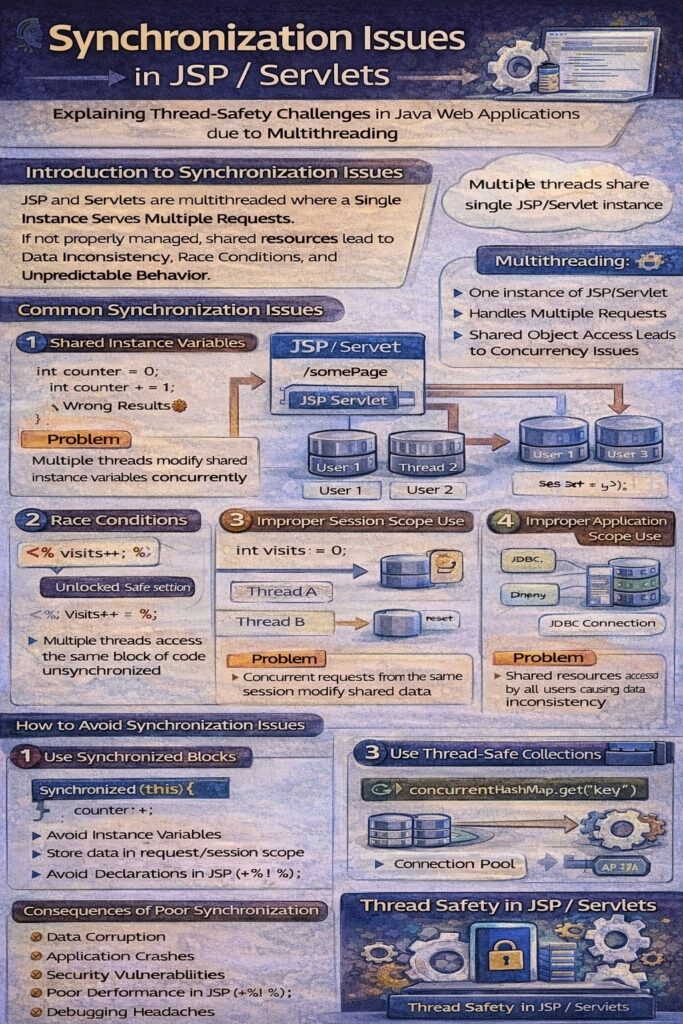
Why Synchronization Issues Occur
Synchronization issues mainly occur because:
- Only one instance of a servlet or JSP is created
- Multiple threads access the same instance concurrently
- Shared variables are modified by multiple requests at the same time
This situation leads to concurrent access problems.
Multithreading in JSP and Servlets
- Each HTTP request is handled by a separate thread
- Threads share the same servlet/JSP instance
- Local variables are thread-safe
- Instance variables are shared and not thread-safe by default
Common Synchronization Issues
1. Shared Instance Variables
Problem
Instance variables declared in servlets or JSP declarations are shared across all threads.
Example
int counter = 0;
Multiple requests updating this variable simultaneously can result in incorrect values.
Impact
- Data corruption
- Inconsistent output
- Unreliable application behavior
2. JSP Declarations and Thread Safety
Problem
Variables declared using JSP declarations (<%! %>) become instance variables.
Example
<%! int visits = 0; %>
<% visits++; %>
Multiple users accessing this page at the same time can cause incorrect visit counts.
3. Race Conditions
Problem
Two or more threads attempt to modify shared data simultaneously, and the final result depends on the execution order.
Impact
- Incorrect calculations
- Lost updates
- Unpredictable results
4. Improper Use of Session and Application Scope
Session Scope Issues
- Data shared incorrectly between requests
- Multiple concurrent requests from the same user
Application Scope Issues
- Shared data accessed by all users
- High risk of synchronization problems
5. Database and Resource Access Issues
Problem
- Multiple threads using the same database connection
- Improper connection pooling
- Unclosed resources
Impact
- Data inconsistency
- Deadlocks
- Performance degradation
Synchronization in JSP and Servlets
1. Using Synchronized Blocks
synchronized(this) {
    counter++;
}
Ensures that only one thread accesses the critical section at a time.
2. Using Synchronized Methods
public synchronized void updateCounter() {
    counter++;
}
Locks the entire method, preventing concurrent access.
3. Avoiding Instance Variables
- Use local variables whenever possible
- Store user-specific data in request or session scope
4. Thread-Safe Data Structures
- Use thread-safe collections (e.g.,
ConcurrentHashMap) - Avoid shared mutable objects
5. Proper Scope Management
- Use page and request scope for temporary data
- Limit use of application scope
- Clean session data after use
Deprecated Approach: SingleThreadModel
- Ensured only one thread accessed servlet at a time
- Caused performance issues
- Deprecated and not recommended
Best Practices to Avoid Synchronization Issues
- Minimize shared data
- Avoid JSP declarations for mutable variables
- Use local variables in scriptlets
- Use proper synchronization carefully
- Use connection pools for database access
- Follow MVC architecture strictly
Consequences of Poor Synchronization
- Incorrect data
- Application crashes
- Security vulnerabilities
- Poor performance
- Difficult debugging
Conclusion
Synchronization issues in JSP and servlets arise due to the multithreaded execution model of web containers. Shared instance variables, improper scope usage, and unsynchronized access to resources can lead to serious data consistency and performance problems. By understanding thread behavior and applying proper synchronization techniques and best practices, developers can build efficient, scalable, and thread-safe Java web applications.