
Below is a clear, structured, and in-depth explanation of the Servlet API.
Servlet API
Introduction
The Servlet API is a set of interfaces, classes, and methods provided by Java to develop server-side web applications. It defines the standard way in which a servlet interacts with a web container, handles client requests, and generates dynamic responses.
The Servlet API acts as a bridge between the client and the server, allowing Java programs to run inside a web server environment.
Purpose of Servlet API
The Servlet API is designed to:
- Handle client–server communication
- Process HTTP requests and responses
- Manage sessions and application data
- Provide lifecycle management of servlets
- Enable scalable and secure web applications
Architecture of Servlet API
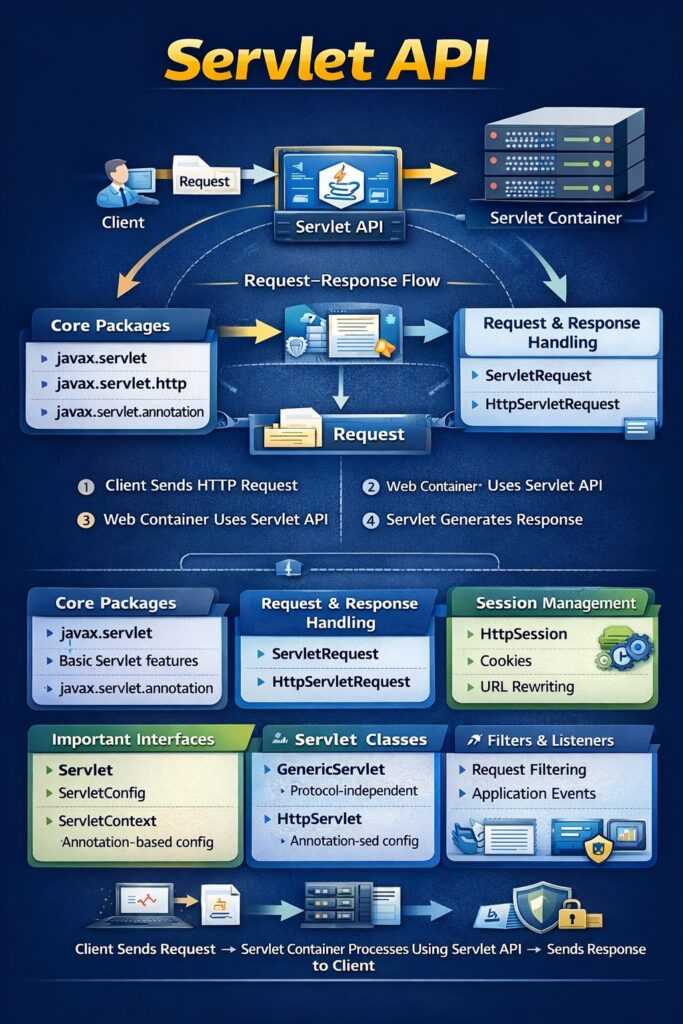
The Servlet API operates within a request–response architecture, where:
- Client sends a request
- Web container processes the request using Servlet API
- Servlet generates response
- Response is sent back to the client
Core Packages of Servlet API
| Package | Description |
|---|---|
javax.servlet | Basic servlet functionality |
javax.servlet.http | HTTP-specific features |
javax.servlet.annotation | Annotation-based configuration |
Important Interfaces in Servlet API
1. Servlet Interface
The root interface for all servlets.
Key Methods:
init()service()destroy()getServletConfig()getServletInfo()
2. ServletConfig Interface
Used to provide servlet-specific configuration information.
Responsibilities:
- Reading initialization parameters
- Accessing
ServletContext
3. ServletContext Interface
Represents the entire web application.
Uses:
- Share data between servlets
- Read application-wide parameters
- Manage resources
Important Classes in Servlet API
GenericServlet
- Protocol-independent
- Base class for all servlets
- Implements
ServletandServletConfig
HttpServlet
- Designed specifically for HTTP protocol
- Most commonly used servlet class
- Provides methods such as:
doGet()doPost()doPut()doDelete()
Request and Response Handling
ServletRequest / HttpServletRequest
Provides access to:
- Client parameters
- Headers
- Cookies
- Input streams
- Session object
ServletResponse / HttpServletResponse
Used to:
- Send output to client
- Set response content type
- Set status codes
- Redirect responses
Session Management in Servlet API
The Servlet API provides session tracking mechanisms such as:
HttpSession- Cookies
- URL rewriting
- Hidden form fields
📌 Session data is stored on the server side.
Request Dispatching
RequestDispatcher Interface
Used to:
- Forward requests
- Include resources (JSP, servlets)
RequestDispatcher rd = request.getRequestDispatcher("home.jsp");
rd.forward(request, response);
Filters and Listeners
Filters
Used for:
- Authentication
- Logging
- Data validation
- Compression
Listeners
Used to:
- Track application lifecycle
- Monitor session creation and destruction
- Handle request events
Configuration Methods
Deployment Descriptor (web.xml)
Defines:
- Servlet mapping
- Initialization parameters
- Security constraints
Annotations
@WebServlet("/login")
- Simplifies servlet configuration
- Reduces XML usage
Advantages of Servlet API
- Platform independent
- High performance
- Multithreaded architecture
- Secure and scalable
- Backbone of Java web frameworks
Limitations
- Requires explicit thread safety handling
- HTML generation can be complex
- Tight coupling with HTTP protocol
Conclusion
The Servlet API provides a powerful and standardized framework for building server-side Java web applications. By offering well-defined interfaces and classes, it enables efficient handling of client requests, lifecycle management, session control, and integration with modern Java web technologies. It forms the core foundation upon which higher-level frameworks and enterprise applications are built.