
Below is a clear, deep, and professional explanation of the Java Servlet Development Kit (Servlet API / SDK).
Java Servlet Development Kit (Servlet API)
Introduction
The Java Servlet Development Kit, commonly referred to as the Servlet API, is a collection of interfaces and classes provided by Java to develop server-side web applications. It allows developers to create servlets that handle client requests, perform business logic, and generate dynamic responses.
The Servlet API is part of Java Enterprise Edition (Jakarta EE) and is executed inside a Servlet Container such as Apache Tomcat, Jetty, GlassFish, or WebLogic.
Purpose of Servlet Development Kit
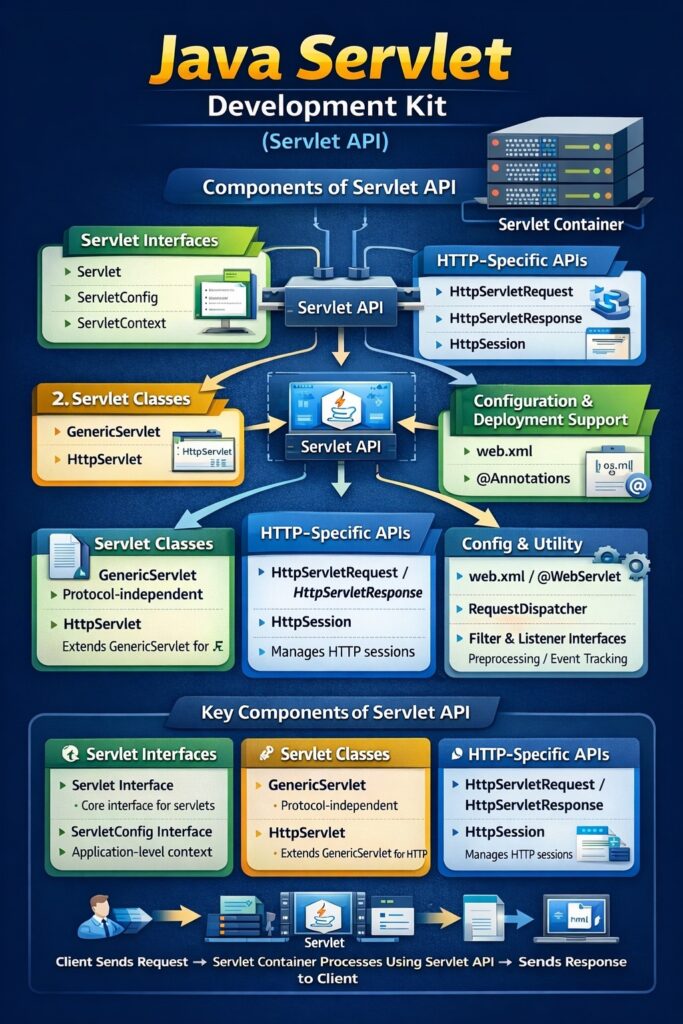
The Servlet Development Kit provides:
- Standard APIs to build web components
- A protocol-independent request–response mechanism
- Integration with HTTP-based web applications
- A foundation for frameworks like JSP, Struts, Spring MVC
Components of Java Servlet Development Kit
The Servlet Development Kit mainly consists of the following components:
- Servlet Interfaces
- Servlet Classes
- HTTP-Specific APIs
- Configuration & Deployment Support
- Utility and Supporting Interfaces
1. Servlet Interfaces
Servlet Interface
public interface Servlet
This is the core interface of the Servlet API. Any servlet must ultimately implement this interface.
Key Methods:
init(ServletConfig config)service(ServletRequest request, ServletResponse response)destroy()getServletConfig()getServletInfo()
📌 Developers usually do not implement this interface directly.
ServletConfig Interface
Used to provide initialization parameters to a servlet.
Responsibilities:
- Access servlet-specific configuration
- Provide reference to
ServletContext
ServletContext Interface
Represents the entire web application, not a single servlet.
Uses:
- Sharing data among servlets
- Reading application-level parameters
- Resource management
📌 One ServletContext per web application.
2. Servlet Classes
GenericServlet
public abstract class GenericServlet
- Protocol-independent servlet
- Implements
ServletandServletConfig - Used when protocol is not HTTP
📌 Rarely used in real-world web applications.
HttpServlet
public abstract class HttpServlet
- Most widely used servlet class
- Designed specifically for HTTP protocol
- Provides HTTP method handling
Important Methods:
doGet()doPost()doPut()doDelete()doHead()
📌 Almost all web servlets extend HttpServlet.
3. HTTP-Specific APIs
HttpServletRequest
Represents the client request.
Provides access to:
- Request parameters
- Headers
- Cookies
- Session object
- Request body data
HttpServletResponse
Represents the response sent to client.
Used for:
- Sending HTML / JSON / XML output
- Setting status codes
- Redirecting responses
- Writing output streams
HttpSession
Used for session management.
Features:
- Maintains user data across requests
- Stored on server side
- Identified using session ID
4. Configuration and Deployment Support
web.xml (Deployment Descriptor)
Used to configure servlets declaratively.
Contains:
- Servlet definitions
- URL mappings
- Initialization parameters
- Security constraints
Annotations (Modern Approach)
@WebServlet("/login")
- Eliminates need for
web.xml - Simplifies configuration
- Preferred in modern applications
5. Utility and Supporting Interfaces
RequestDispatcher
Used for request forwarding and inclusion.
request.getRequestDispatcher("home.jsp").forward(request, response);
Filter Interface
Used for:
- Authentication
- Logging
- Data validation
- Request preprocessing
Listener Interfaces
Used to track:
- Application events
- Session lifecycle
- Request lifecycle
Working of Servlet Development Kit
- Client sends HTTP request
- Servlet container receives request
- Container uses Servlet API to:
- Create request & response objects
- Invoke servlet methods
- Servlet processes request
- Response is sent back to client
Advantages of Servlet Development Kit
- Platform independent
- High performance (multithreaded)
- Secure and robust
- Scalable for enterprise applications
- Backbone of Java web frameworks
Limitations
- Requires explicit coding
- UI generation is complex compared to JSP
- Thread safety must be handled carefully
Conclusion
The Java Servlet Development Kit provides a standardized and powerful foundation for building server-side Java web applications. By offering a well-defined set of interfaces and classes, it enables seamless interaction between client requests and server responses. The Servlet API plays a critical role in modern Java web development and serves as the backbone for higher-level frameworks and enterprise solutions.