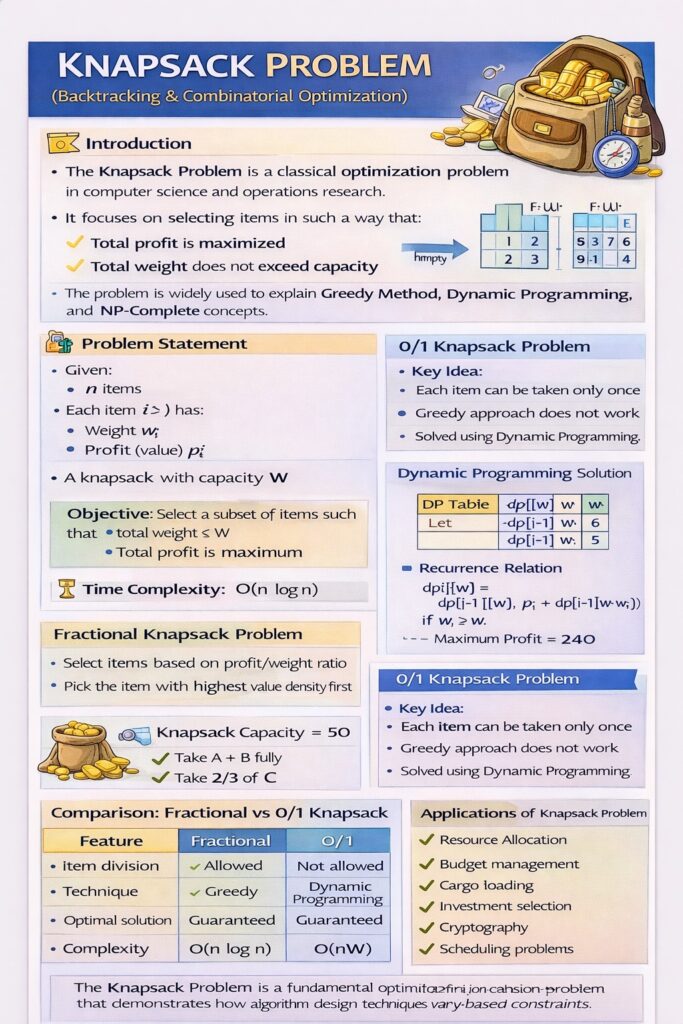
📘 Knapsack Problem
1️⃣ Introduction
The Knapsack Problem is a classical optimization problem in computer science and operations research.
It focuses on selecting items in such a way that:
- Total profit is maximized
- Total weight does not exceed capacity
The problem is widely used to explain Greedy Method, Dynamic Programming, and NP-Complete concepts.
2️⃣ Problem Statement
Given:
- n items
- Each item i has:
- Weight
wᵢ - Profit (value)
pᵢ
- Weight
- A knapsack with capacity W
Objective:
Select a subset of items such that
🔹 Total weight ≤ W
🔹 Total profit is maximum
3️⃣ Types of Knapsack Problem
🔹 1. Fractional Knapsack
- Items can be broken into fractions
- Solved using Greedy Approach
🔹 2. 0/1 Knapsack
- Items are indivisible
- Either take the item (1) or leave it (0)
- Solved using Dynamic Programming
4️⃣ Fractional Knapsack Problem
🔹 Key Idea
- Select items based on profit/weight ratio
- Pick the item with highest value density first
🔹 Algorithm (Greedy)
- Calculate
pᵢ / wᵢfor each item - Sort items in descending order
- Add items fully or partially until capacity is filled
🔹 Example
Items:
| Item | Weight | Profit | p/w |
|---|---|---|---|
| A | 10 | 60 | 6 |
| B | 20 | 100 | 5 |
| C | 30 | 120 | 4 |
Knapsack Capacity = 50
✔ Take A + B fully
✔ Take 2/3 of C
Maximum Profit = 240
🔹 Time Complexity
- O(n log n) (sorting)
5️⃣ 0/1 Knapsack Problem
🔹 Key Idea
- Each item can be taken only once
- Greedy approach does not work
- Solved using Dynamic Programming
6️⃣ Dynamic Programming Solution (0/1 Knapsack)
🔹 DP Table
Let:
dp[i][w] = maximum profit using first i items and capacity w
🔹 Recurrence Relation
[
dp[i][w] =
\begin{cases}
dp[i-1][w] & \text{if } w_i > w \
\max(dp[i-1][w],; p_i + dp[i-1][w-w_i]) & \text{if } w_i \le w
\end{cases}
]
🔹 Algorithm Steps
- Create DP table of size
(n+1) × (W+1) - Fill table row by row
- Final answer =
dp[n][W]
🔹 Time & Space Complexity
- Time Complexity: O(nW)
- Space Complexity: O(nW)
7️⃣ Comparison: Fractional vs 0/1 Knapsack
| Feature | Fractional | 0/1 |
|---|---|---|
| Item division | Allowed | Not allowed |
| Technique | Greedy | Dynamic Programming |
| Optimal solution | Guaranteed | Guaranteed |
| Complexity | O(n log n) | O(nW) |
| Nature | Polynomial | NP-Complete |
8️⃣ Applications of Knapsack Problem
- Resource allocation
- Budget management
- Cargo loading
- Investment selection
- Cryptography
- Scheduling problems
9️⃣ Advantages and Limitations
✔ Advantages
- Models real-life optimization problems
- Demonstrates DP and Greedy techniques
- Guarantees optimal solution (DP)
✖ Limitations
- High memory usage (DP)
- Large W makes DP impractical
- NP-Complete (0/1 version)
🔚 Conclusion
The Knapsack Problem is a fundamental optimization problem that demonstrates how algorithm design techniques vary based on constraints.
Fractional Knapsack is solved greedily, while 0/1 Knapsack requires Dynamic Programming for optimal results.