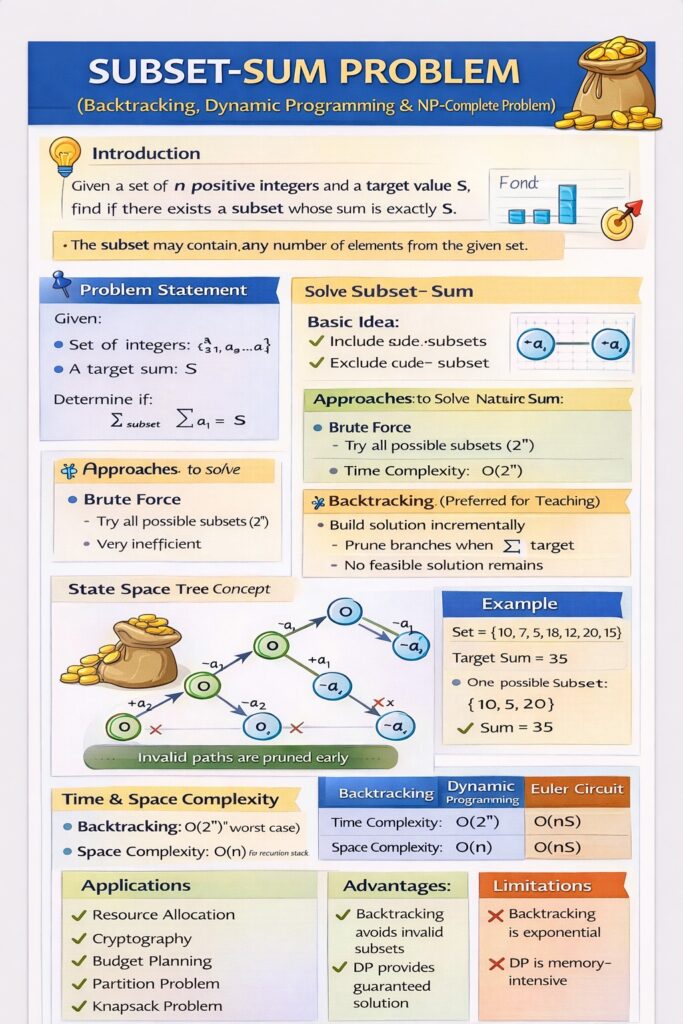
📘 Subset–Sum Problem
1️⃣ Introduction
The Subset–Sum Problem is a classical problem in algorithm design and computational complexity.
🔹 Definition
Given a set of n positive integers and a target value S, determine whether there exists a subset whose sum is exactly S.
The subset may contain any number of elements from the given set.
2️⃣ Problem Statement
Given:
- A set of integers:
[
A = {a_1, a_2, a_3, \dots, a_n}
] - A target sum: S
Determine whether:
[
\sum_{i \in subset} a_i = S
]
3️⃣ Nature of the Problem
- Decision problem (Yes/No answer)
- Belongs to the class of NP-Complete problems
- Used as a base problem for proving NP-completeness of other problems
4️⃣ Approaches to Solve Subset–Sum
🔹 1. Brute Force
- Try all possible subsets (2ⁿ)
- Very inefficient
Time Complexity: O(2ⁿ)
🔹 2. Backtracking (Preferred for Teaching)
- Build solution incrementally
- Prune branches when:
- Sum exceeds target
- No feasible solution remains
🔹 3. Dynamic Programming
- Converts exponential time to pseudo-polynomial time
- Guarantees optimal solution
5️⃣ Subset–Sum Using Backtracking
🔹 Basic Idea
At each step, decide:
- Include current element
- Exclude current element
If partial sum:
- Equals S → solution found
- Exceeds S → backtrack
6️⃣ State Space Tree Concept
- Each level represents an element
- Left branch → include element
- Right branch → exclude element
- Invalid paths are pruned early
7️⃣ Algorithm (Backtracking Approach)
🔹 Pseudocode
SubsetSum(i, current_sum):
   if current_sum == S:
       print subset
       return true
   if i == n or current_sum > S:
       return false

   // Include element
   if SubsetSum(i+1, current_sum + a[i]):
       return true

   // Exclude element
   if SubsetSum(i+1, current_sum):
       return true

   return false
8️⃣ Example
🔹 Given:
Set = {10, 7, 5, 18, 12, 20, 15}
Target Sum = 35
🔹 One Possible Subset:
[
{10, 5, 20}
]
✔ Sum = 35
9️⃣ Time and Space Complexity
🔹 Backtracking
- Time Complexity: O(2ⁿ) (worst case)
- Space Complexity: O(n) (recursion stack)
🔹 Dynamic Programming
- Time Complexity: O(nS)
- Space Complexity: O(nS)
🔟 Subset–Sum Using Dynamic Programming
🔹 DP Table
dp[i][j]= true if sum j is possible using first i elements
🔹 Recurrence Relation
[
dp[i][j] =
\begin{cases}
dp[i-1][j] \quad \text{or} \quad dp[i-1][j-a_i] & j \ge a_i \
dp[i-1][j] & j < a_i
\end{cases}
]
1️⃣1️⃣ Applications
- Resource allocation
- Cryptography
- Budget planning
- Partition problem
- Knapsack problem
1️⃣2️⃣ Advantages and Limitations
✔ Advantages
- Backtracking prunes invalid subsets
- DP provides guaranteed solution
✖ Limitations
- Backtracking is exponential
- DP is memory-intensive
🔚 Conclusion
The Subset–Sum Problem is a foundational NP-Complete problem that demonstrates the power of backtracking and dynamic programming in solving combinatorial problems.
Subset–Sum explores whether a target can be formed by selecting a subset of given numbers.