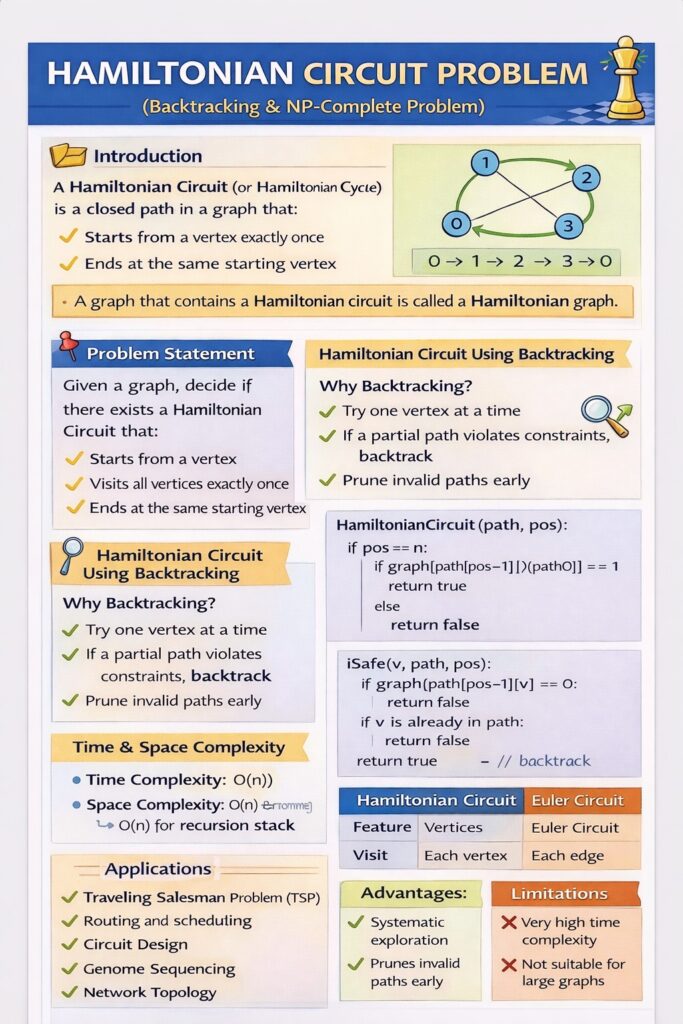
📘 Hamiltonian Circuit Problem
1️⃣ Introduction
The Hamiltonian Circuit Problem is a classic problem in graph theory and algorithm design.
🔹 Definition
A Hamiltonian Circuit (or Hamiltonian Cycle) is a closed path in a graph that:
- Visits each vertex exactly once
- Returns to the starting vertex
A graph that contains a Hamiltonian circuit is called a Hamiltonian graph.
2️⃣ Problem Statement
Given a graph G(V, E), determine whether there exists a Hamiltonian Circuit that:
- Starts from a vertex
- Visits all vertices exactly once
- Ends at the same starting vertex
3️⃣ Key Characteristics
- Each vertex appears once (except start/end)
- Circuit must include all vertices
- Applicable to directed and undirected graphs
- Different from Euler Circuit (edges vs vertices)
4️⃣ Why Hamiltonian Circuit is Difficult
- Number of possible paths grows factorially
- Requires checking all permutations of vertices
- No known polynomial-time solution
📌 Hence, it belongs to the class of NP-Complete problems
5️⃣ Hamiltonian Circuit Using Backtracking
🔹 Why Backtracking?
- Try one vertex at a time
- If a partial path violates constraints, backtrack
- Prune invalid paths early
6️⃣ Representation
- Graph represented using adjacency matrix
- Use an array
path[]to store the current path
📌 path[i] stores the vertex at position i in the Hamiltonian path
7️⃣ Algorithm Logic (Backtracking Approach)
🔹 Steps
- Start from vertex
0 - Add one vertex at a time to the path
- Check:
- Vertex is not already included
- There is an edge from previous vertex
- If path includes all vertices:
- Check edge from last vertex to first
- If not valid, backtrack
8️⃣ Pseudocode for Hamiltonian Circuit
HamiltonianCircuit(path, pos):
   if pos == n:
       if graph[path[pos-1]][path[0]] == 1:
           return true
       else
           return false

   for v = 1 to n-1:
       if isSafe(v, path, pos):
           path[pos] = v
           if HamiltonianCircuit(path, pos + 1):
               return true
           path[pos] = -1   // backtrack
   return false
🔹 isSafe Function
isSafe(v, path, pos):
   if graph[path[pos-1]][v] == 0:
       return false
   if v is already in path:
       return false
   return true
9️⃣ Example
🔹 Graph with 4 Vertices
Vertices: {0, 1, 2, 3}
One Hamiltonian Circuit:
0 → 1 → 2 → 3 → 0
✔ Visits all vertices once
✔ Returns to starting vertex
🔟 Time and Space Complexity
🔹 Time Complexity
- Worst Case: O(n!)
- Due to checking all permutations of vertices
🔹 Space Complexity
- Path array: O(n)
- Recursion stack: O(n)
1️⃣1️⃣ Comparison: Hamiltonian vs Euler Circuit
| Feature | Hamiltonian Circuit | Euler Circuit |
|---|---|---|
| Focus | Vertices | Edges |
| Visit | Each vertex once | Each edge once |
| Complexity | NP-Complete | Polynomial |
| Condition | No simple rule | Degree-based rules |
1️⃣2️⃣ Applications
- Traveling Salesman Problem (TSP)
- Routing and scheduling
- Circuit design
- Genome sequencing
- Network topology
1️⃣3️⃣ Advantages of Backtracking Approach
✔ Systematic exploration
✔ Prunes invalid paths early
✔ Easy to understand
1️⃣4️⃣ Limitations
✖ Very high time complexity
✖ Not suitable for large graphs
🔚 Conclusion
The Hamiltonian Circuit Problem is a fundamental problem that demonstrates the power and limitations of backtracking and highlights the challenges of NP-Complete problems.
Hamiltonian Circuit focuses on visiting all vertices exactly once in a closed loop.