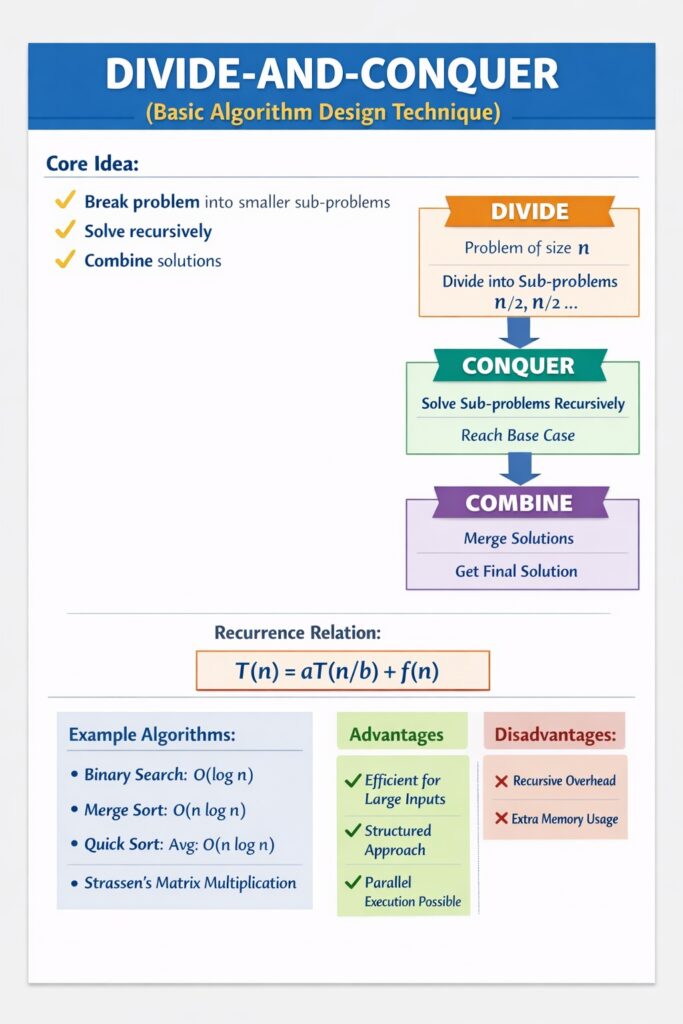
📘 Divide-and-Conquer
(Basic Algorithm Design Technique)
1️⃣ Introduction
Divide-and-Conquer is a fundamental algorithm design technique in which a problem is:
- Divided into smaller sub-problems
- Solved recursively
- Combined to obtain the final solution
This technique is especially effective for problems that can be broken into independent sub-problems of the same type.
2️⃣ General Strategy of Divide-and-Conquer
The Divide-and-Conquer approach consists of three main steps:
🔹 1. Divide
Split the problem of size n into smaller sub-problems, usually of size n/2.
🔹 2. Conquer
Solve each sub-problem recursively.
If the sub-problem is small enough, solve it directly (base case).
🔹 3. Combine
Combine the solutions of sub-problems to form the solution of the original problem.
3️⃣ Mathematical Representation
The time complexity of divide-and-conquer algorithms is usually expressed using a recurrence relation:
[
T(n) = aT\left(\frac{n}{b}\right) + f(n)
]
Where:
- a = number of sub-problems
- n/b = size of each sub-problem
- f(n) = cost of dividing and combining
4️⃣ Example Algorithms Using Divide-and-Conquer
🔹 1. Binary Search
Idea:
Divide the sorted array into two halves and search recursively.
Recurrence Relation:
[
T(n) = T(n/2) + O(1)
]
Time Complexity:
- Best Case: O(1)
- Worst Case: O(log n)
🔹 2. Merge Sort
Idea:
Divide the array into two halves, sort them recursively, and merge.
Recurrence Relation:
[
T(n) = 2T(n/2) + O(n)
]
Time Complexity:
- Best / Average / Worst Case: O(n log n)
🔹 3. Quick Sort
Idea:
Partition the array around a pivot and sort sub-arrays recursively.
Recurrence Relation:
- Best/Average Case:
[
T(n) = 2T(n/2) + O(n)
] - Worst Case:
[
T(n) = T(n-1) + O(n)
]
Time Complexity:
- Best/Average: O(n log n)
- Worst: O(n²)
🔹 4. Strassen’s Matrix Multiplication
Recurrence Relation:
[
T(n) = 7T(n/2) + O(n^2)
]
Time Complexity:
[
O(n^{\log_2 7}) \approx O(n^{2.81})
]
5️⃣ Advantages of Divide-and-Conquer
- Reduces problem complexity
- Efficient for large input sizes
- Enables parallel processing
- Elegant and structured approach
6️⃣ Disadvantages of Divide-and-Conquer
- Recursive overhead
- Higher space usage (stack memory)
- Not suitable for all problems
- Combining step may be costly
7️⃣ Comparison with Other Techniques
| Technique | Strategy | Example |
|---|---|---|
| Divide-and-Conquer | Divide → Solve → Combine | Merge Sort |
| Greedy | Local optimal choice | Kruskal |
| Dynamic Programming | Store sub-problem results | Knapsack |
| Backtracking | Try all possibilities | N-Queen |
8️⃣ Applications of Divide-and-Conquer
- Searching (Binary Search)
- Sorting (Merge Sort, Quick Sort)
- Matrix multiplication
- Computational geometry
- Large data processing
9️⃣ Exam-Oriented Key Points
- Always mention three steps
- Write recurrence relation
- Solve using Master Theorem
- Use examples
🔚 Conclusion
Divide-and-Conquer is a powerful and widely used algorithm design technique that simplifies complex problems by breaking them into smaller manageable sub-problems.
Divide-and-Conquer transforms complex problems into simpler ones through recursion.