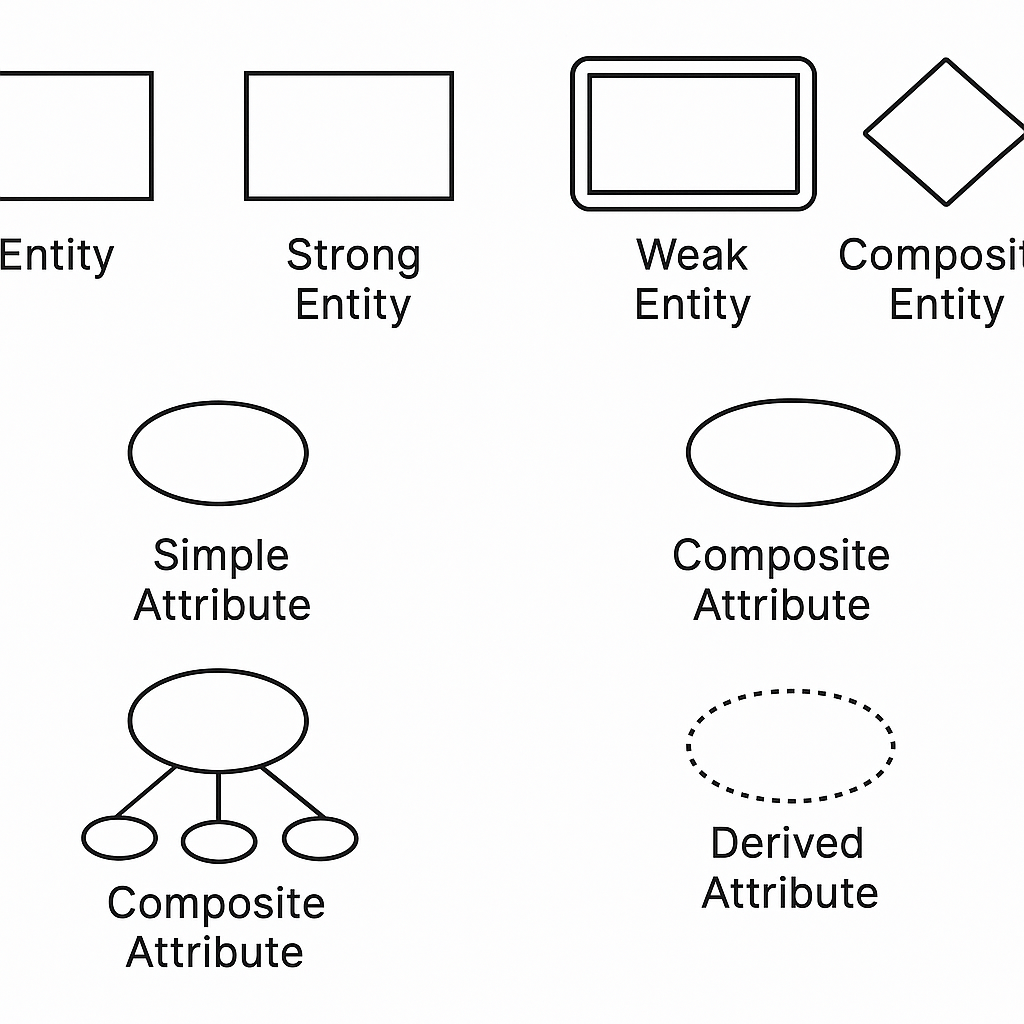
Here is a clear, neat, exam-friendly explanation of ERD symbols for:
✔ Entity
✔ Types of Entities
✔ Weak Entity
✔ Strong Entity
✔ Composite Entity (Associative Entity)
I’ll include diagrams in ASCII format so you understand the shapes.
ERD SYMBOLS (ENTITY TYPES)
1. ENTITY (Basic Entity)
An entity is represented by a rectangle.
+-----------+
|  Entity   |
+-----------+
Example:
+-----------+
| STUDENT   |
+-----------+
2. STRONG ENTITY (Regular Entity)
A strong entity has its own primary key and does NOT depend on another entity.
Symbol: Single rectangle.
+-----------------+
|  STUDENT        |   <-- Strong Entity
+-----------------+
Primary key is underlined:
+-------------------------+
| STUDENT                 |
| ----------------------- |
| RollNo (PK)             |
| Name                    |
| Age                     |
+-------------------------+
3. WEAK ENTITY
A weak entity does NOT have a primary key of its own.
It depends on a strong entity for identification.
Symbol: Double rectangle
+=================+
|| DEPENDENT     ||
+=================+
Weak entity uses partial key, which is a dashed underline:
+=========================+
|| DEPENDENT             ||
|| --------------------- ||
|| Name (partial key)    ||
|| Age                   ||
+=========================+
Relationship with its strong entity is an identifying relationship (double diamond):
+-----------+     <>==<>     +=================+
| EMPLOYEE  | ----||---------|| DEPENDENT     ||
+-----------+     <>==<>     +=================+
4. COMPOSITE ENTITY (ASSOCIATIVE ENTITY / BRIDGE ENTITY)
Used to represent M:N relationships as a separate entity.
Symbol:
A normal rectangle used between two entities, but it represents a relationship turned into an entity.
Example: Student enrolls in Course (M:N relationship)
+----------+         +-------------+         +----------+
| STUDENT  |---------| ENROLLMENT |---------| COURSE   |
+----------+         +-------------+         +----------+
Where ENROLLMENT is the composite (associative) entity.
Attributes of Composite Entity:
+-----------------------+
| ENROLLMENT            |
| --------------------- |
| RollNo (FK)           |
| CourseID (FK)         |
| DateOfJoin            |
+-----------------------+
Use case:
- Converts M:N relationship into two 1:M relationships.
- Contains attributes of the relationship (e.g., date, marks).
5. OTHER ATTRIBUTE SYMBOLS (BONUS)
These commonly appear in exams, so included for clarity:
Simple Attribute
Single oval:
    (Name)
      |
+----------+
| STUDENT  |
+----------+
Composite Attribute
Oval with smaller ovals:
        (Address)
         /   |   \
   (City) (State) (Pincode)
Multi-valued Attribute
Double oval:
((Phone))
    |
+----------+
| STUDENT  |
+----------+
Derived Attribute
Dotted oval:
(...Age...)
      |
+-----------+
| STUDENT   |
+-----------+
SUMMARY TABLE
| Concept | Symbol |
|---|---|
| Strong Entity | Single Rectangle |
| Weak Entity | Double Rectangle |
| Composite Entity | Rectangle used for M:N relationship with FK attributes |
| Simple Attribute | Single Oval |
| Composite Attribute | Oval connected to small ovals |
| Multi-valued Attribute | Double Oval |
| Derived Attribute | Dotted Oval |